

How To Draw Fight Scenes
Anime And Manga
How to Draw Manga! Tips and Tricks: Action Scene Basics Introduction
Action scenes are a primal role of any manga, whether they be a placid shoujo to a shounen mecha showdown. Action scenes are a dynamic activeness driven panel showing a fight or action against an inanimate object, or a passionate realisation. All of these follow a similar formula to create the action sequence.
Setting the Scene
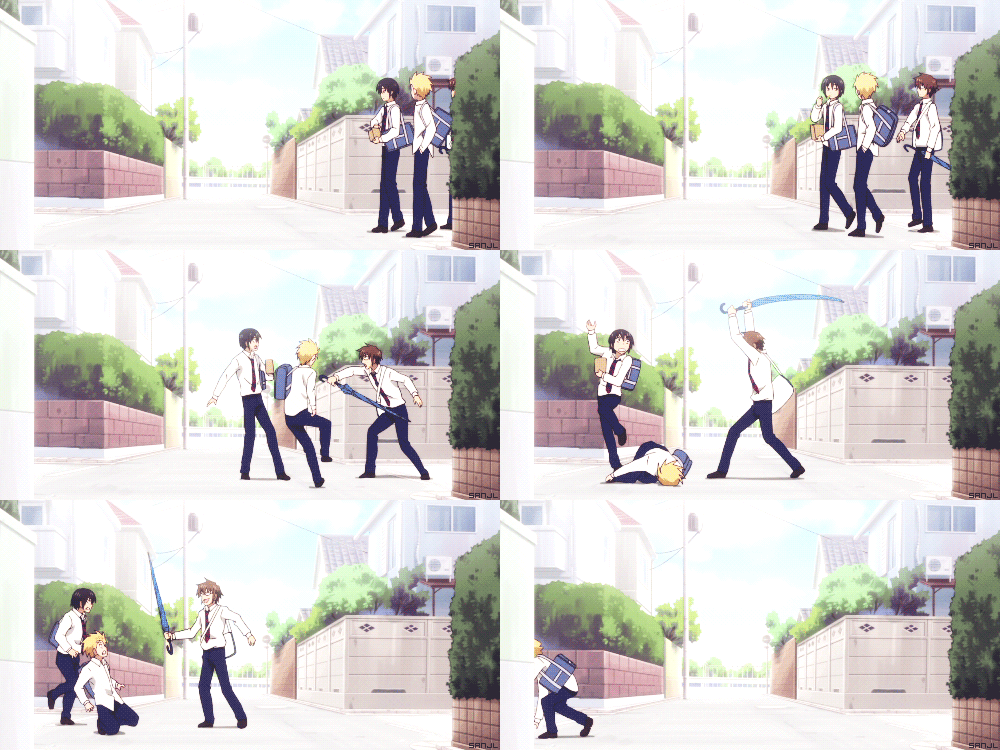
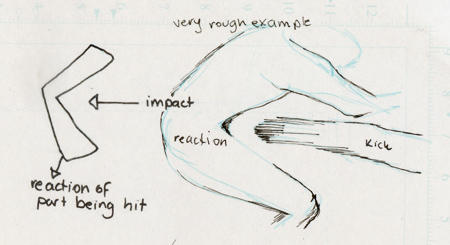
When creating an action scene offset consider the what action is being performed and how the two objects/subjects are interacting, i.e. testify the force of the movement. For a person, it they are beingness hitting, they will reaction in accordance to the forcefulness applied.A mutual way of achieving this is using the < shape to betoken where they are beingness striking. Take into consideration anatomy; if a person is being hitting in the stomach they will produce a nice < shape with their caput and shoulders coming forwards, whilst the hip becomes the point at the back, merely if they are hitting in the middle of the back in that location is non every bit much of a > shape, more a slight tilting of the head dorsum, but piffling else. In another example, hitting the back of the genu will crusade a person to crumple, just hitting the forepart direct would just push their weight backwards (and pb them into kick back). In the rough example below, the figure is being kicked square in the stomach, sending them backwards. Flaying out arms and legs will give fifty-fifty more motion and 'power' to the kick. If the person is impacting a hard object they may 'bounce' a little subsequently striking information technology.
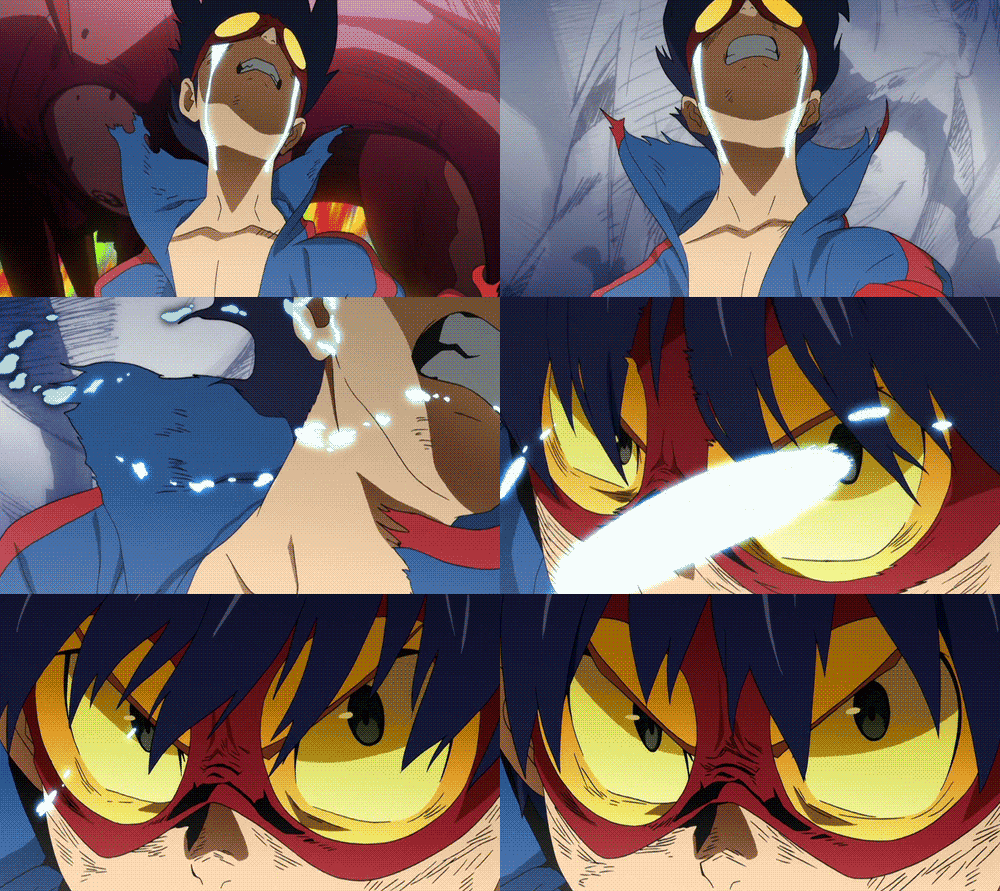
Other useful effects include using shut ups of faces and fists or feet to indicate the shut combat and typically when fighting someone, the characters are looking at their opponent, angling the 'camera' to catch this emotion and gaze adds to the intensity of the activity sequence. Showing expressions such every bit gritting their teeth, grimacing or yelling are also means to convey the action sequence.
Characters being attacked need to react to their opponent, whether it'south to exist hit or to contrivance a striking, their expression and movement needs to be considered as they demand to react as much equally the 'hero' of the scene.
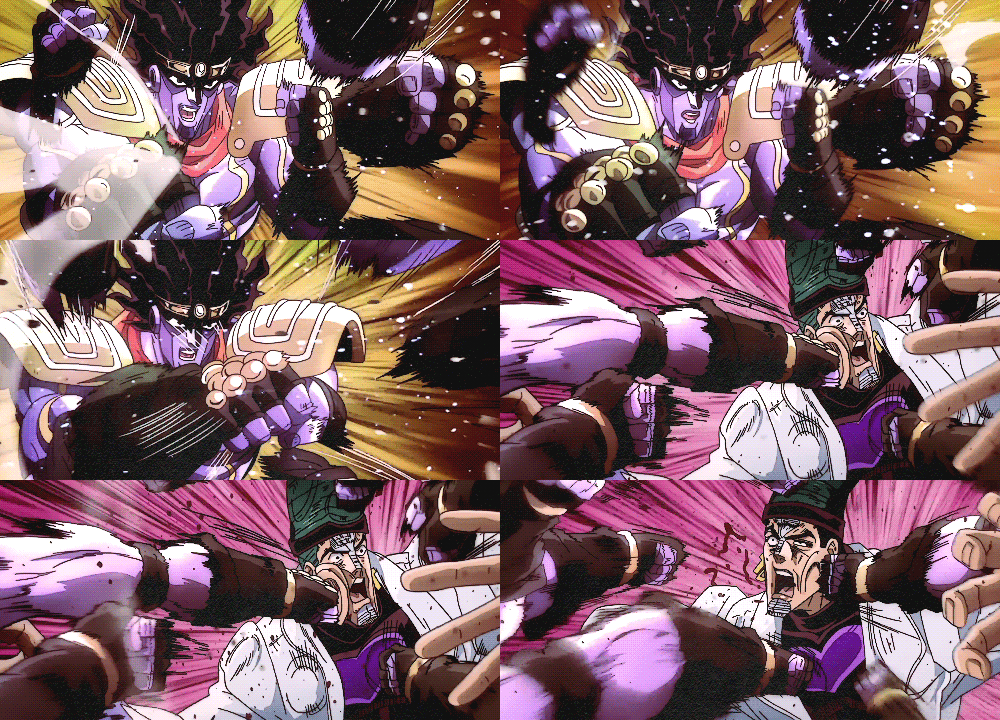
A slightly more avant-garde bones technique is called 'many sections' which is portraying a fist or kick hitting and so apace it seems equally if the grapheme has multiple arms or legs. A perfect example of this is Jotaro in the manga Jo Jo's Bizarre Adventure, his principal technique is fast flight punches from his Stand, Star Platinum. This technique is not but used for the 'aggressor'; the 'victim' can be shown with multiple heads or arms to indicate the multiple points of impact.
Using Line Furnishings
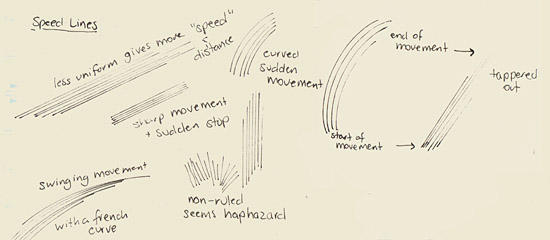
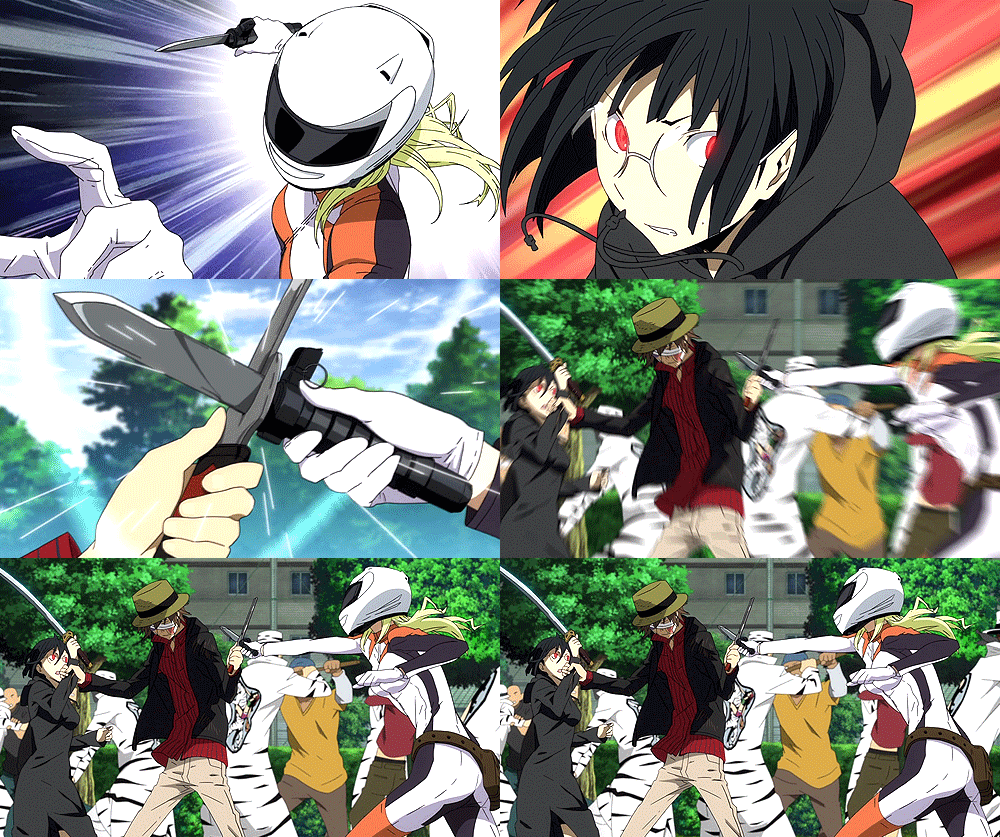
Lines and hatching techniques are outlined in Tips and Tricks: Pen and Ink Techniques Article These can be used to convey a sense of speed by changing the line art and adding in impact points and speed lines to help. Hairstyles tin also be manipulated to show the force at which the character is expressing the activity, using speed lines and gradating speed lines to change the intensity. Modifying the management and adding in 'sweat drops' or 'blood splatters' will also increment the effect. The following case shows non-gradated speed lines made with a multi-liner, and gradated are lines that are thicker at one cease. Speed lines are typically ruled, as non-ruled seem haphazard and tin can exist made to start and cease at the aforementioned point, indicating sudden movement (sudden showtime, sudden stop). Also tin can have different start and stop points per line or even be curved using a french curve or ellipses. Speed-lines can be used to replace sections of line art of the moving object to give it the sense of moving.
Beta-flashes are too a useful part of an activity scene, they can indicate a sudden thought or sound. They can be uniform, different shapes or even curved with a French curve. The key part of a beta-flash is they have a centre that all the lines intersect with. A common arroyo is to gradate the lines towards the middle, but don't cross it. The following example only shows these lines, it was fabricated with a 0.1 technical pen. The lines are more useful if thicker at one terminate as the background is typically coloured black.
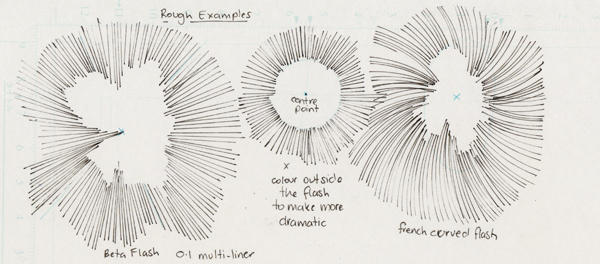
A terminal 'activeness' technique is the touch. It tin can be a freehand jagged spoken language bubble, or have a a combination of speed lines or a be a partial beta-wink. It doesn't fifty-fifty need to be a full airtight point, it can exist just the top or side, depending on the desired effect.

Screentones and screen tone effects can also exist used to produce speed-lines and beta-flashes without having to draw them each fourth dimension, the only drawback with this (other then needing to take them on manus) is that they are not as unique as having drawn them yourself, only they are an easy shortcut.
References, Tutorials and Guides
The post-obit guides and tutorials become over these ideas in much greater detail and provide some great reference poses to assist:
Action scenes are all nigh movement, reaction and effects. Plan out your artwork to where you want your characters interacting and what they are interacting with and modify your lineart to colouring to produce the sense of movement.
 Want to advise a theme or provide article content? Desire to see other articles?
Visit: Tips and Tricks: Introduction and Primary List



Source: https://www.deviantart.com/khallandra/journal/Tips-and-Tricks-Action-Scene-Basics-550328006
Posted by: jacksonhimmen1955.blogspot.com
0 Response to "How To Draw Fight Scenes"
Post a Comment